Service
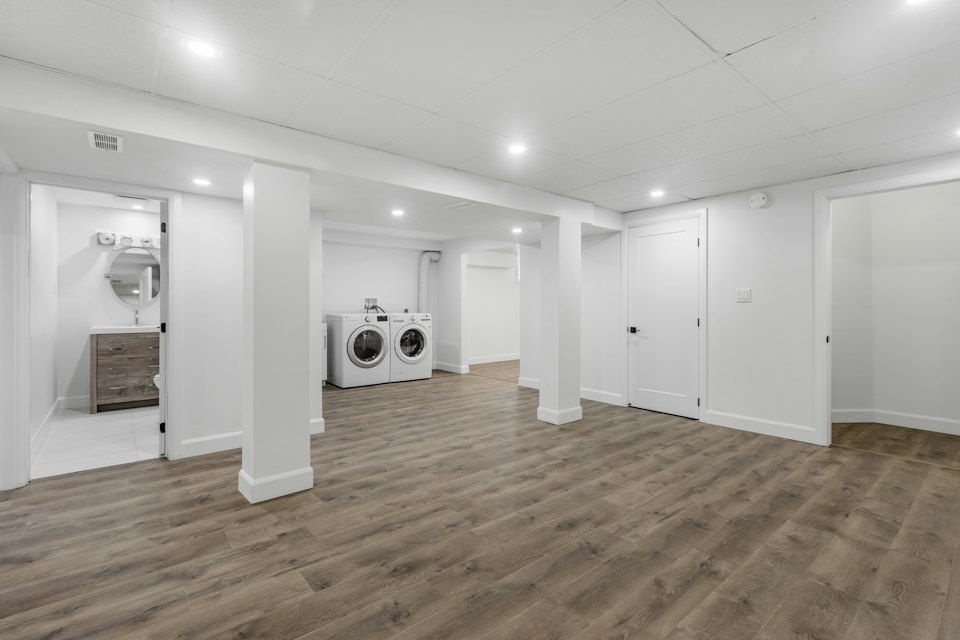
Basement Remodeling & Finishing.
A finished basement starts with a dry, stable one. We resolve active moisture and foundation issues first, then design the layout and finishes on top.
The Right Order
Dry first. Then build.
Enclosing a basement that still takes on water hides the problem behind new walls and makes it harder to fix later. So the sequence matters: assess and resolve active moisture and foundation issues, then frame, insulate, and finish.
From there the work is a stack — sub-floor that tolerates moisture, walls assembled for the climate, ceilings that keep mechanicals reachable, and trim that matches the rest of the house.
If your basement has a moisture history, that is not a reason to give up on finishing it. It is a reason to handle the water work first, in the same project or before it.
Scope
What remodeling and finishing includes.
Layout & planning
How the space gets divided and used, planned around the foundation, ceiling height, and utilities.
Framing & walls
Framing and wall assemblies selected for a below-grade space, with vapor and moisture management.
Flooring & sub-floor
Moisture-tolerant sub-floor and finish flooring appropriate to the room and use.
Ceilings & access
Ceiling systems chosen around keeping mechanicals reachable.
Lighting & ventilation
Layered lighting and ventilation that make a windowless room feel comfortable.
Finishes & millwork
Trim, paint, and built-ins detailed to match the rest of the home.
Limitation: finishing cannot substitute for waterproofing. Before framing, we confirm the moisture and structural work is done or scheduled. If it is not, that becomes step one — see the waterproofing overview.
Common Signs
Before you finish: signs to handle first.
If any of these are present, the moisture work comes before the finishing.
Any history of water, dampness, or a musty smell.
Efflorescence or peeling paint on the walls.
A sump that runs during wet periods.
Cracks or a wall that looks out of line.
High humidity in summer.
Earlier finishes that failed early.
Any one of these points to something worth inspecting — not a confirmed cause. The assessment sorts that out.
What We Assess
What we check before finishing.
- Moisture history and current humidity.
- Foundation and floor condition.
- Ceiling height, egress, and utility locations.
- Layout goals and how the space will be used.
- Ventilation and mechanical capacity.
- Permit and inspection requirements.
How the Work Goes
How the build goes.
- Resolve moisture and structural issues first.
- Plan the layout around the foundation and utilities.
- Frame, insulate, and manage vapor.
- Mechanicals, lighting, and inspections.
- Finishes, trim, and a final walkthrough.
Remodeling Specialties
Room-specific finishing.
Once the basement is dry, these are the finishing scopes we build.
Entertainment & Recreation →
Theaters, bars, game rooms.
Extra Living Space →
Suites, bedrooms, bathrooms.
Workrooms & Studios →
Offices and studios.
Specialty Rooms →
Wine cellars, galleries, safe rooms.
Lighting & Electrical →
Layered light and controls.
HVAC & Climate →
Comfort and humidity.
Storage & Utility →
Built-ins and mechanical rooms.
Local Context
Pre-1990s block walls need a different assembly.
Many older Bergen County homes sit on concrete-block foundations rather than poured concrete. The two dry differently and do not tolerate the same assemblies. We pick the wall stack by what is actually there, not by what the last basement used.
Questions
Straight answers about remodeling.
Do I need to waterproof before finishing?
Can I use the basement during the work?
Do you handle permits and inspections?
What about the warranty?
Can remodeling and waterproofing be one project?
Ready to make the basement usable?
Start with an assessment so the build sits on a dry foundation.